

The Hidden Genius
Why Your Best Work is Invisible

I gave a talk last month in Austin at the New Media Summit all about giving yourself the best chance for success as a creator and what’s working now.
The one thing I got the most feedback on was something that I almost didn’t include. It was probably the last slide I added to the entire presentation.
It was the concept of the Hidden Genius. Let me give you some context here.
The 2 Variables of Success
After studying hundreds of creators, and spending thousands of hours researching, I realized something: every success story comes down to 2 variables:
Momentum is the level of awareness a creator has. When you have momentum, growth becomes easier. Opportunities come your way, and the whole process becomes more enjoyable. People with zero momentum often haven’t given their work the best chance of breaking out and being shared by others. Momentum is when your work starts moving without you pushing every time.
Insanely Valuable content is the kind that makes people reply “I can’t believe this is free.” It helps someone make money, save money, save time, learn something, be entertained, or some combination of those. It’s the difference between “meh, that was okay” and “I have to share this with a friend right now.” I spoke in depth about this here if you want to learn more.
I decided to plot this out to visually show this:
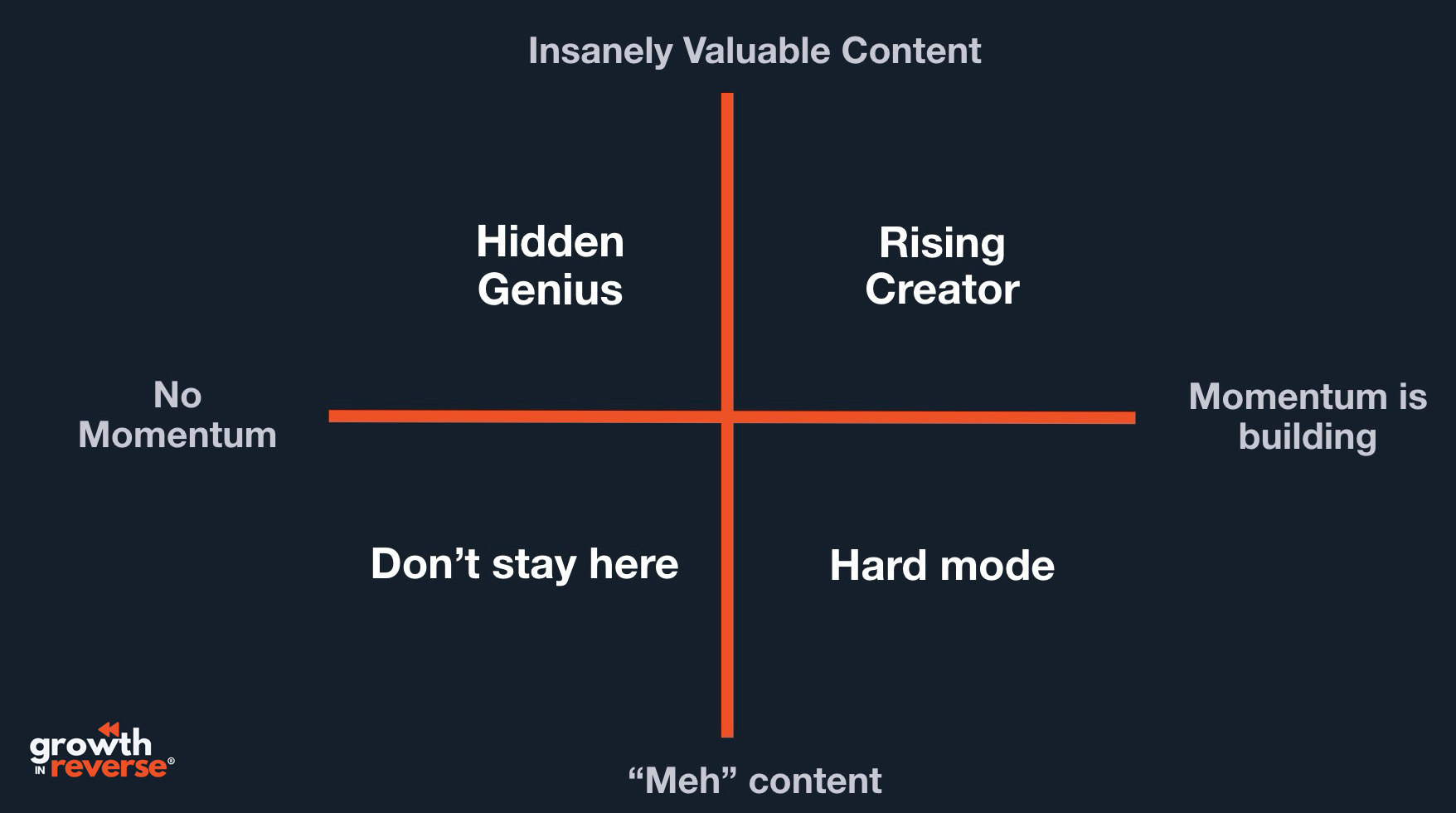
Let’s talk about each of these 4 quadrants:
“Don’t Stay Here” – on the bottom left are the people who have “meh” content and don’t have any momentum. I just labeled this one “don’t stay here” because honestly, most of us start at this point. We’re figuring it out, and that’s okay. If you stay there too long, you’ll fizzle out. And if you’ve been at this a while and are still here, something needs to change.
Hard Mode – the bottom right are the people who are creating so much momentum, but their content isn’t that good. The people they are attracting are leaving and feeling let down. I call this hard mode because if they just put a little more effort into their work, the momentum they worked so hard to build would pay off and they’d find themselves in the “Rising Creator” space. Life would be easier.
The Rising Creator – the top right is where insanely valuable content meets consistent distribution. Your work compounds. People share it for you and growth starts to feel easier.
The last one is what I call The Hidden Genius. These are the people who work so hard at creating great work, but don’t spend any time on promotion. They aren’t willing, or are too afraid, to put their craft out into the world.
After this talk, I had more than a handful of people tell me they resonated heavily with the “hidden genius” side of things. And that always breaks my heart.
The Richest Place on Earth
There’s a quote I keep coming back to, from the great Les Brown:
“The graveyard is the richest place on earth, because it is here that you will find all the hopes and dreams that were never fulfilled, the books that were never written, the songs that were never sung, the inventions that were never shared, the cures that were never discovered, all because someone was too afraid to take that first step, keep with the problem, or determined to carry out their dream.” – Les Brown
That absolutely wrecks me every time I think about it.
People didn’t give life to their ideas. Whether it was fear, social norms, or just never feeling ready – their genius stayed buried. And that sucks.
What is a Hidden Genius?
A hidden genius is someone who pours days, weeks, sometimes months or even years into making something genuinely great. They put their heart and soul into it, giving everything they can – but they never share it with the world.
Maybe they hit publish. But they don’t tell anyone. They don’t talk about it. It just sits out there, undiscovered.
I see it constantly.
So many creators are deeply talented, deeply committed to their craft. But they’re so focused on the work itself that they completely neglect the other half: getting it in front of people.
Why Does This Happen?
There are a few layers here, and I’ll call out 3 of them. There are probably many more to add to the list, but I think 90% of them boil up to this first one.
Fear.
Fear of looking dumb. Fear of getting feedback you don’t want to hear. Fear of saying something stupid.
Fear of this thing you’re so tied and so excited by, not getting the feedback you want to hear. Or fear of what people will think – friends, family, even some random stranger on the internet.
You see all those negative comments online and think, “Can I handle that? Can I sustain having people throw negativity at me after I’ve poured my heart into something?”
But fear comes in many shapes and sizes.
This whole thing is scary. I’m not going to pretend it isn’t.
Perfectionism.
As a creative person, you have great taste. And it becomes excruciatingly painful how far apart you are now, from being “good” at a thing. But that’s the name of the game.
In an interview in the early 2000s, Ira Glass, host of This American Life, said one of the most profound things I’ve ever heard on this topic:
“All of us who do creative work … we get into it because we have good taste. But it’s like there’s a gap, that for the first couple years that you’re making stuff, what you’re making isn’t so good, OK? It’s not that great. It’s really not that great. It’s trying to be good, it has ambition to be good, but it’s not quite that good.
But your taste — the thing that got you into the game — your taste is still killer, and your taste is good enough that you can tell that what you’re making is kind of a disappointment to you.” – Ira Glass
That hits me like a ton of bricks every time I hear it.
He goes on to say that this is the point where most people give up. They can’t stand how horrible their work might be, without realizing that it takes time to get better.
And this perfectionism plays a HUGE role in keeping people from sharing their work.
And even if you get past fear, there’s another layer.
The Moral Objection to Marketing.
A lot of creators (especially the really thoughtful ones) have this visceral reaction to anything that feels like “marketing.” You see the sleazy tactics, the clickbait, the noise from big corporations, and want no part of it.
I get that. But by avoiding all promotion, you’re handicapping your own growth.
You’re making it exponentially harder for anyone to find your work. And sadly, it’s usually the work the world needs the most.
If your work is valuable enough, you are doing a disservice to the people who need it most by not sharing.
You have this incredible knowledge, art, creativity that could actually change someone’s life and you’re not getting it into more hands because you “hate marketing?”
If you’re not making any effort to showcase what you’re doing, you’re going to have a really hard time building an audience, growing your reach, and most importantly, making enough money to keep creating.
Be Your Own Johanna
Think about Van Gogh – the man never saw his work take off in his lifetime. He sold one painting while he was alive. One.
His genius was only discovered after he was gone.
How did he get famous after he had passed? His sister-in-law, Johanna van Gogh-Bonger, became his promoter. She organized exhibitions. She loaned paintings to galleries. She hustled her ass off to get his work out there.
She spent decades doing this. And eventually, it worked. Van Gogh became one of the most recognized artists in history.
But it took someone actively, relentlessly promoting his work to make that happen. If she hadn’t done that, his incredible work would have died with him.
Even Van Gogh, one of the greatest painters who ever lived, needed someone to promote him. His genius alone wasn’t enough. Johanna was the one who got his work in front of people.
If you’re just waiting to be discovered, you might be waiting forever.
I’m not saying that newsletters are the same as famous paintings, but the underlying message holds true. Most of us don’t have a Johanna, so we have to be our own.
Break the Seal
There’s a creator named Colin Landforce who tweeted something recently that I loved.
Colin is incredible at short-form video these days and well-known in the golf space for his content. He knows what hits, what doesn’t, and he’s become well known in the space, even teaching other creators how to create short-form video.
When he got started with video a few years ago, his first ones were about basketball cards. It wasn’t that he was all-in on basketball. He loved basketball cards, but he didn’t think he was going to make money on cards.
But he knew it was something he could talk about over and over again to break the seal of content creation.
He used this to figure out what worked and how to create insanely valuable content. When he did make the switch to golf, he had learned so much about content creation that it became easier to stand out and not feel all the fear and uncertainty of being a complete beginner again.
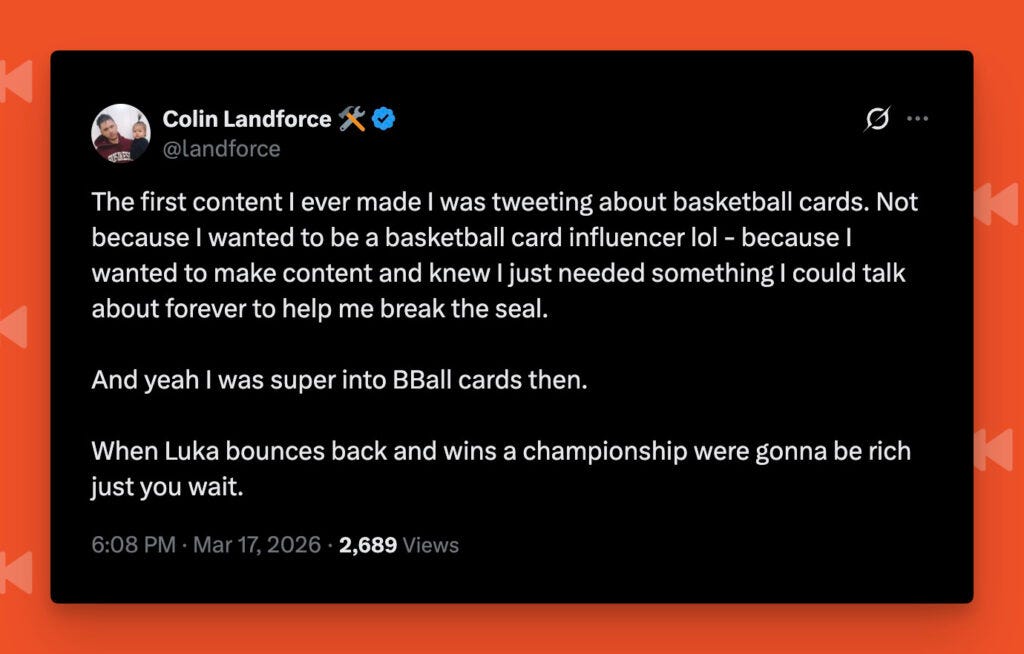
I love that framing.
Find something you’re willing to screw up in order to learn what works. Maybe it’s something you love but not quite the thing you want to do forever.
If he had started with golf, Colin might not have put himself out there in the same way.
I think it’s an incredible place to get started. Maybe even more so then when you find your true “thing.”
This is one of the easiest ways to escape the Hidden Genius trap.
Because when we find our thing, the topic we’re deeply passionate about, it actually becomes harder to share.
You want to do it right. You don’t want to look like an idiot. The stakes feel so high.
But there’s a learning curve to putting yourself out there. There’s a format you have to figure out. It’s a whole new game. And sometimes the best move is to practice with something that feels lower-stakes, just to build the muscle.
The irony is that once you find the thing you’re most excited about, you get so nervous about messing it up that you freeze.
Just know that momentum doesn’t come from going viral. It comes from consistently putting your work in front of people: sharing it, talking about it, and giving it multiple chances to be seen.
The Vicious Cycle
The vicious cycle of it all becomes one of doing nothing.
You spend a ton of time on a piece of content. But you’re scared. You don’t share it. Nobody sees it. You don’t get good feedback, but you don’t get bad feedback either.
And you start the next thing, and you don’t share that either.
No feedback, just you, living in your head, thinking you’re on the right path without really knowing.
Now you’re stuck in a cycle where your best work (the stuff you spent the most time on) never reaches anyone.
You’re not getting feedback. You don’t know where you can improve.
Hell, you don’t even know if you actually enjoy the topic, or just the idea of the topic.
You might think something is your “thing” until you post about it a few dozen times and realize, “Nope, I’m done with that.”
But without posting or sharing, you never figure that out.
And to be honest, sometimes the reason it stays hidden is because it hasn’t been tested yet. Feedback helps turn good work into great work.
It Never Fully Goes Away
I don’t think we ever fully get past this. Every time you start something new, this fear can creep back in.
I used to write deep dives every week, putting 40-60 hours into each piece – it became unsustainable as I wanted to podcast, and launch a community.
But deep dives were the thing I had become known for. The reason people shared my work with others. So when I stopped writing deep dives, I felt like anything I published that wasn’t a full deep dive wasn’t “worthy.”
I stopped posting much on social media, sharing those pieces with friends. Sure, they went out to the email list, but that was literally it.
And you know what? People loved the shorter ones – and some even thought the shorter posts were deep dives anyway.
So who was I to say my own work wasn’t valuable enough to promote widely?
The Real Cost of Staying Hidden
There are an infinite number of good ideas in the world. But ideas that never get shared for others to enjoy and learn from? They might as well not exist.
Don’t let that be you.
Your genius is too important to stay hidden. Even if it’s scary, even if you don’t feel ready, even if you’re not sure anyone will care, share it anyway.
Tell a few people. Post it on social. Send it to a friend. Don’t worry about “building momentum” – just break the silence.
The world needs fewer hidden geniuses and more people brave enough to share their creativity with the world.
Don’t let the graveyard be the only place that gets to enjoy your work.
These posts appear first on my website: https://growthinreverse.com/hidden-genius/
You nailed it with this matrix, Chenell. High-value content isn’t enough — you need to create momentum too.
Love the framework.